Currently Empty: ₹0.00
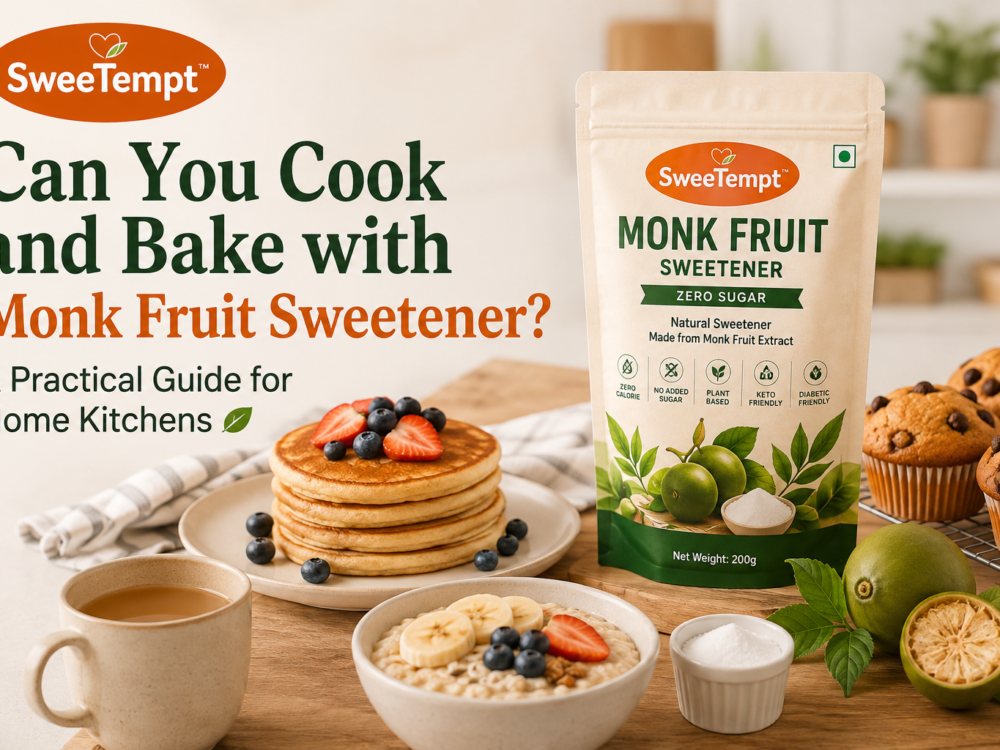
You use monk fruit sweetener to sweeten your coffee or morning tea regularly, and it seems to be doing quite a satisfactory job. But recently, you find yourself wondering… is this actually where the versatility of monk fruit sweetener ends? Can it be stirred into a pancake batter or mixed into a quick weeknight bowl of oatmeal? More importantly, if baking is one of your favorite pastimes on lazy Sunday mornings, does monk fruit sweetener measure up in actual recipe baking, or is it limited to the realm of just sweetening your drinks?
The plain and simple truth: Yes, you can bake and cook with monk fruit sweetener. However, – and this is often where the nuance gets lost – it’s not always a straightforward one-to-one substitution; that much is indisputable.
Often, in the rush to remove sugar, people tend to forget its profound role beyond adding sweetness. Sugar impacts how foods hold moisture, how textures develop, how things brown, and even how a bake holds together. Consequently, when you introduce an alternative, a period of trial and error is inherent in the process. Nevertheless, overhauling your cooking repertoire to incorporate this sweetener is absolutely achievable.
In all honesty, the most sensible approach to get started is by attempting to make dishes you already prepare routinely.
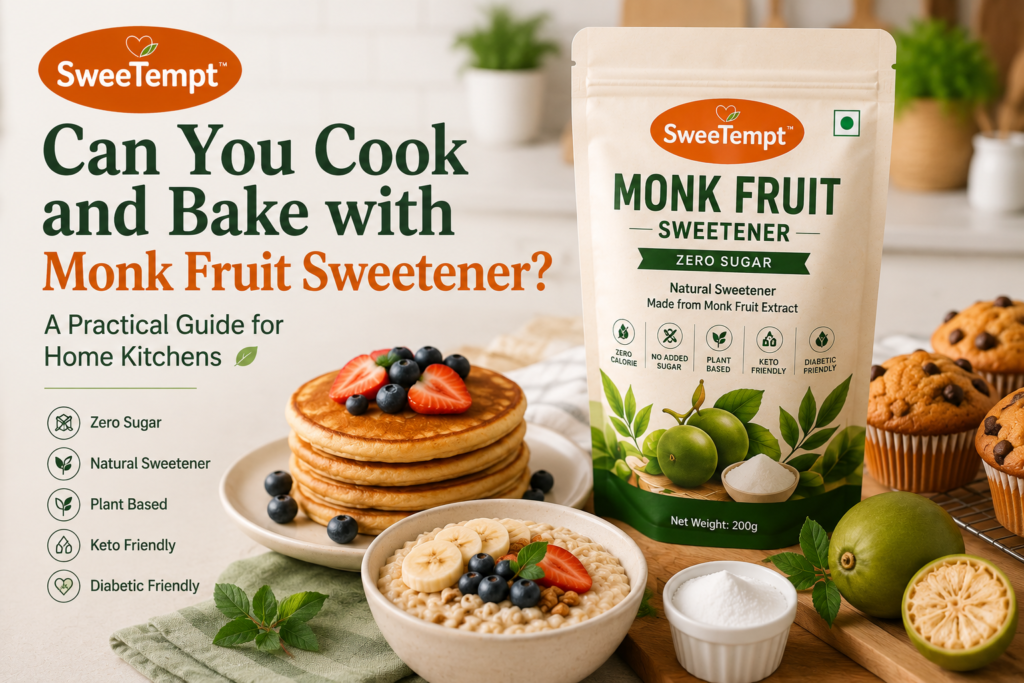
Start with What You Currently Make.
It doesn’t pay to tackle a complicated new cake recipe when you’ve not yet attempted it with standard ingredients. You might even want to postpone this process if it’s something you’re unlikely to make often, if at all.
Instead, consider what regularly graces your plate throughout a typical week. For many, this would include a Sunday pancake, a rushed Tuesday morning bowl of oats, a kid-friendly smoothie prepared on the fly, or a quick batch of muffins when your sweet cravings strike.
These options actually make for the best possible test cases, why do you ask? Because you have already experienced a hundred variations of these meals with regular sugar so that when you switch sweeteners, you will immediately detect any changes without the need to second guess whether the outcome is “as it should be.” Simply take your go-to pancake recipe and try substituting sugar for monk fruit sweetener while keeping all other ingredients exactly the same.
Then, observe the result.
It’s truly that simple, that complete, and no other experiment will be required; cooking for real has always required actually cooking something and seeing what happens.
It’s Easy to Use in Drinks – hot or iced
Beyond sweetened tea and coffee (which is surely already in your routine), there is more range for its application than you might initially assume, especially for things like smoothies, iced drinks, and homemade breakfast bowls.
One vital point to note: how a drink is formulated, be it hot or cold, can significantly influence the perceived sweetness. The “right amount” in hot tea might not have the same effect in a cold smoothie, and sweetness varies intensely from person to person anyway – a quantity adequate for one individual may be over or under the mark for another within your home. This means rather than pouring an entire spoon into the beverage, it is more judicious to pour just a portion.
You will have no difficulty adding more if needed.
The challenge is attempting to retrieve a portion that has already been added. A minor guideline that avoids a lot of puzzled “why does it taste this way” exclamations.
Now, back to baking:
This step is invariably more problematic, as it generally contributes most to all the confusing discourse surrounding the topic. Since sugar has multiple responsibilities when baked, such as influencing coloration, controlling moisture levels, and impact on overall texture, you can expect a difference when substituting a monk fruit baking sweetener. Therefore, do not set out blindly if you decide to bake with it, but rather attempt to gain some insight into what exactly a given recipe has as an end goal for it.
I can only suggest starting with a simpler bake like pancakes, muffins, bars, or the occasional sweet treat; anything less will only pose problems, rather than opportunities for enjoyment.
Furthermore, if you are a person who decides to undertake a baking experience for the first time with a sweetener like this, i personally recommend the preparation of a limited quantity only. Trust, you truly wish not to have prepared a tray of what might not be enjoyed by those around the table!
Pancakes are really quite likely the perfect beginning point
If you have not as yet settled on the ideal place to start a baking venture: by all means,begin with pancakes. For starters, all you should already have are your standard ingredients for pancakes, whether it be some eggs, milk, flour, and what kind of seasoning you desire. Whenever you do get the recipe to call for sugar, simply exchange it for monk fruit sweetener, and adjust for your individual preferences as needed.
After all, no one will be looking!
Additionally, consider other additives such as cinnamon or vanilla that have such amazing properties for imparting aroma and flavour, such as chopped berries or nut.
These ingredients alter flavour drastically, so attempt to do not discount the sweetness imparted solely from the sweetener because there is a multitude of different flavor and aroma additions within that particular meal. Just like waffles or any basic breakfast you commonly cook this type of meal, the approach to be used is the same…
Oatmeal and breakfast bowls will also do nicely
Other safe environments in which to engage in a cooking exploration is with breakfast dishes that are not quite as delicate to make, such as raw oats, which are by and large unremarkable on their own. However, to us, this is merely a benefit because it leaves space for one’s own unique flair to the meal and a dash of this monk fruit sweetener or some plain unsalted seeds can go a remarkably long way, and even a dash of plain un salted seeds or some chopped nuts, and not to mention yogurt as an accompaniment. Home breakfasts provide individuals the perfect opportunity to tailor everything from simple or elegant as you wish.
You don’t necessarily need to overcomplicate things, even for dessert
If your family just can’t get away from sweetness during and after a meal and has an undeniable hankering for desserts, giving up your sweetened dishes on behalf of giving up sugar isn’t really all the necessary. From simple cheesecakes to fruit desserts to creamy puddings to Yogurt-based delights, you can make almost anything with monk fruit sweetener. The main constraint you will encounter is simply not all recipe conversions yield identical results.
A dessert that may convert very easily one time could require modifications with another kind of sweetener.
This is just a part of baking. Baking has continually been a means of finding what works best through cooking; so there is really no difference when it comes to the sweetener itself.
Don’t Forget What Else Is in the Bowl Here’s something I see people get hung up on way more often than they should – it’s so easy to zone in on the sweetener and completely forget about the other parts of the recipe. Case in point: Even a slightly overripe banana will provide a surprising amount of sweetness in a pancake, a muffin, a smoothie. Fresh, ripe berries provide a lot too.
Vanilla extract, a sprinkle of cinnamon, even a small pinch of salt – all of those things affect how something tastes, without being inherently sweet.
So before you reach for the sweetener, take a spoonful (or sip). You might surprise yourself. Keep Your Expectations in Check You absolutely don’t have to act like a perfectionist the first time you substitute. Honestly, I promise – just accept that the very first pancake, the first mug of coffee, isn’t going to be perfect.
But it is true that you do sometimes need to “retrain” your taste buds.
You might use a little too much the first go-around. The second or third batch may not sweeten up perfectly. In reality, that sweet spot (and for those with diabetes, that range of adequate sweetness) is entirely up to you.
That kitchen – not a blog post, not the side of a jar – is where your sweetener decisions actually get made and figured out. Choose a Monk Fruit Sweetener You’ll Actually Use To be fair, if you intend to branch out and use monk fruit sweetener in various recipes (pancakes, coffee, muffins, etc), choosing one you’ll actually use is important.
Is the one you’re considering primarily for your coffee?
Will you only occasionally use it for occasional baking, or on an ongoing basis?
Do you regularly enjoy things like smoothies or breakfast bowls with their use? Answering those kinds of questions can make it clear if one product is likely to suit you better than another. When starting to experiment with monk fruit sweetener – again, just make up your own version. Start out simply with recipes you’re already making now.
Be a Little Bit of Trial and Error Works If substituting a sweetener does sound like a science project to you, simplify it.
Grab just one of your recipes. Grab a tiny scoop. Take a little taste right now and then a small taste later.
Maybe make a tiny note of how it tastes in a kitchen notepad or just in your mind of what you’ll do the next time you reach for monk fruit sweetener. Just doing that will usually lead you where you’re headed. Once you’ve found two or three favorite recipes in your repetoire that call for it, monk fruit sweetener loses that sense of novelty and just…becomes another staple ingredient in your cooking.
It’s as simple as that.
Frequently Asked Questions
Can you cook with monk fruit sweetener?
Yes, monk fruit sweetener is usable for various dishes ranging from hot and cold beverages to a variety of baked goods and some of your favorite breakfast foods, though it’s dependent on each specific dish. You also may use it as a substitute for traditional sugars or other low-carb, or natural, sweeteners in these dishes.
Can you bake with monk fruit sweetener?
Yes, though results vary a bit, Monk FruitSweetener is able to caramelize with heat, which could alter texture and moisture in baked goods versus traditional sugars; but you can typically adjust the measurements when baking with MonkFruit.
What recipes are easiest to make with monk fruit sweetener?
Typically you’ll see more easy and novice users substituting with drinks, smoothies, and oats as it doesn’t interfere greatly with texture and other factors. Once you’ve gain experience you can easily substitute MonkFruitsweetener in recipes for cookies and pancakes, too.
How do I start using monk fruit sweetener?
As we often say at wholehealthliving,”you” – no one else – is in control of determining appropriate portion size. The kitchen is where your sweet tooth can be trained for optimal results. A great way to kick off a health sweet lifestyle would be to begin with recipes you are familiar with and slowly decrease the sweetener you use each time, or increase the natural sweetener within it, until you can maintain a satisfied palate, all at an affordable and sensible price for monksFruitsweetener to match.